

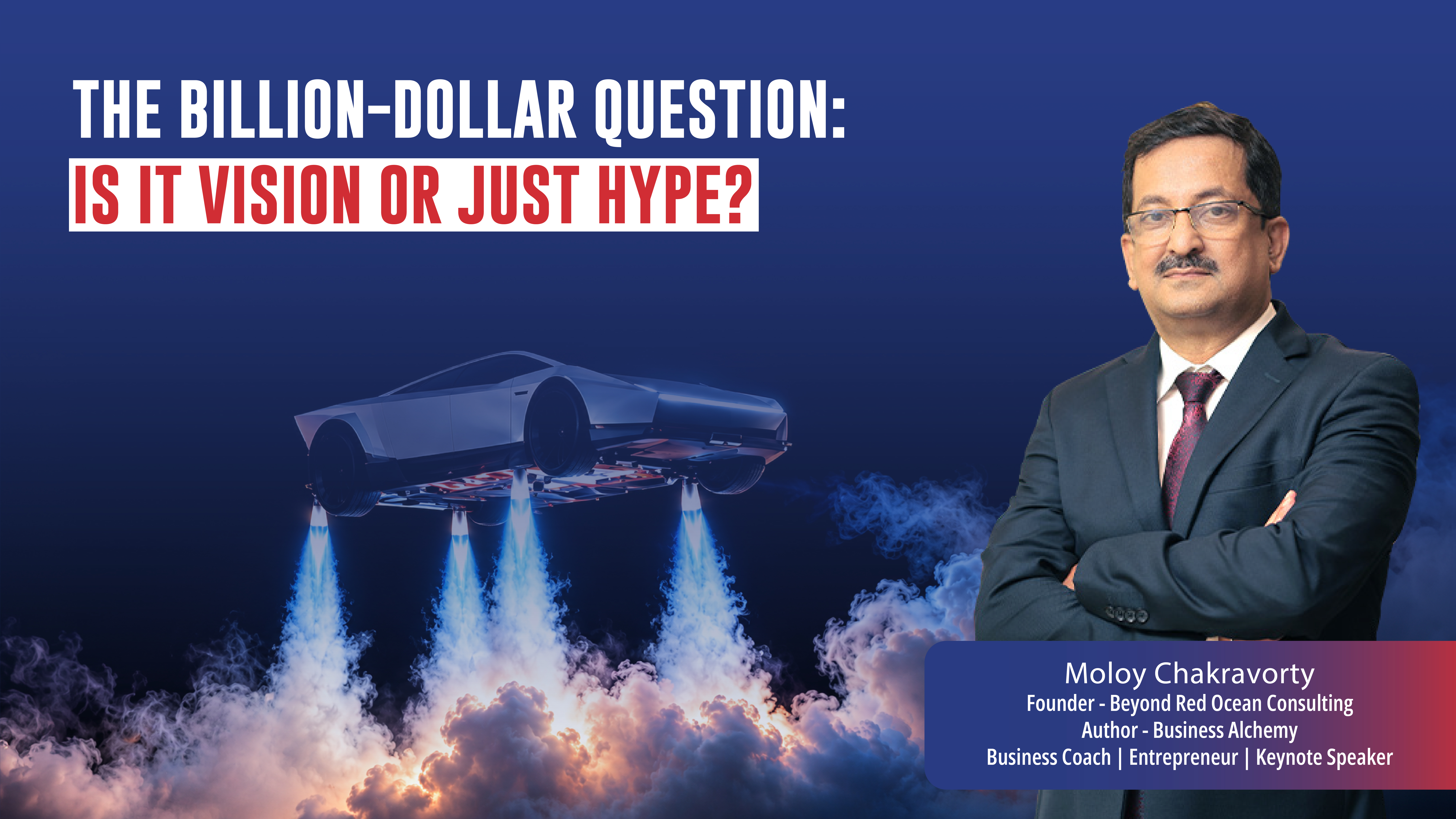
The Billion-Dollar Question: Is It Vision or Just Hype?
When Elon Musk unveiled a car that appeared to defy gravity, the world watched. But the more interesting question is not what the car can do. It is what separates a visionary idea from an expensive distraction.
On October 15, 2026, Tesla demonstrated its long-awaited next-generation Roadster, featuring SpaceX-developed thrusters that allowed the prototype to perform an airborne manoeuvre. The demonstration was extraordinary. Tesla says production is planned for 2028, although the vehicle’s final capabilities and commercial readiness remain to be established.
It is precisely the kind of announcement that gets people talking about the future. But it also raises a question that matters far beyond the automobile industry.
When does vision become genuine value, and when does the excitement surrounding an idea get ahead of its execution?
The Difference Between Seeing and Building
Most businesses are designed around what already works.
They study their competitors, understand established customer expectations and make incremental improvements. There is nothing inherently wrong with this approach. In many industries, consistency and disciplined execution are what protect profitability. But every so often, someone questions the assumptions the rest of the industry has accepted.
Elon Musk has repeatedly built businesses around ambitious propositions, from electric vehicles to reusable rockets. These ventures have faced technical challenges, delays and considerable scepticism. Their significance lies not simply in the ambition of the original idea, but in the engineering, investment and organisational effort required to pursue it.
That distinction matters.
A bold idea is not automatically a good business idea. Equally, an idea that appears commercially impractical today may create an entirely new opportunity if the underlying technology, economics and customer needs evolve.
Vision begins with seeing a possibility others have not taken seriously.
Building a business around that possibility requires considerably more.
When Excitement Becomes a Liability
I have often observed that successful business owners are good at recognising opportunities. It is one of the reasons they have built successful businesses in the first place. The difficulty comes when conviction becomes difficult to question.
An exciting new market appears. Competitors begin entering it. Industry conversations gather momentum. Everyone seems to believe that the opportunity is too significant to ignore.
The natural response is to move quickly. But before committing capital, leadership attention and organisational resources, there are harder questions worth asking.
Is there a genuine customer need?
Can the idea be delivered reliably and at a viable cost?
Does the business possess the capabilities required to execute it?
The most uncomfortable question: If the excitement disappeared tomorrow, would the underlying business case still make sense?
These questions are not intended to discourage ambition. They are what allow ambition to survive contact with reality.
For an established entrepreneur, the cost of a poor decision is rarely limited to the money invested. It can include management bandwidth, delayed priorities, strained teams and opportunities that were overlooked while attention was directed elsewhere.
The price of hype is sometimes what the business never gets around to building.
The Entreprener’s Perspective: Capital Needs Conviction and Discipline
For entrepreneurs and investors with substantial capital at their disposal, the challenge is not simply finding opportunities. It is deciding which opportunities deserve their attention.
Capital can fund experimentation. It can attract talent. It can buy time to solve difficult technical problems.
It cannot guarantee that a market will develop, that customers will pay, or that a promising prototype will become a commercially successful product.
This is where the distinction between a visionary and a speculator becomes important.
A visionary is willing to invest in a future that does not yet exist. But a serious visionary must also understand the assumptions on which that future depends.
- What needs to be true for this investment to work?
- What evidence would strengthen the case?
- What would cause us to reconsider?
These are not questions that weaken conviction. They give conviction a framework within which it can be tested.
The objective is not to eliminate uncertainty. That is impossible when building something genuinely new.
It is to understand which uncertainties are worth taking on.
The Business Lesson Behind the Roadster
The Roadster demonstration captures something fascinating about innovation: the willingness to challenge the boundaries of what a product is expected to do.
Whether every feature translates into a commercially viable product remains a separate question. That distinction is precisely what business leaders should pay attention to.
An impressive demonstration can establish what may be possible. A successful business must establish what can be delivered repeatedly, reliably and profitably.
The two are connected, but they are not the same.
Established businesses face this distinction every time they consider entering a new market, adopting an emerging technology or making a significant strategic investment.
The temptation is to ask, “How big could this become?”
A more useful question is, “What must we build, prove and learn before this opportunity becomes real?”
The first question creates excitement. The second creates a path to execution.
So, Is It Vision Or Just Hype?
Perhaps the answer is not immediately obvious.
A visionary idea can look like hype before its value becomes clear. And hype can look remarkably convincing when expectations are high, and scrutiny is low.
The difference emerges over time, through evidence, execution, and the willingness to confront uncomfortable facts.
As business owners, we should neither dismiss unconventional ideas simply because they challenge existing assumptions nor embrace them simply because they promise an extraordinary future.
We need the imagination to see what could be possible and the discipline to examine what it would take to make it possible.
The real advantage is not being the first to believe in the future. It is knowing how to turn that belief into something that works.
Moloy Chakravorty
Founder - Beyond Red Ocean Consulting
Executive Director - Network In Action, West Bengal
Author - Business Alchemy
Business Coach | Entrepreneur | Keynote Speaker