

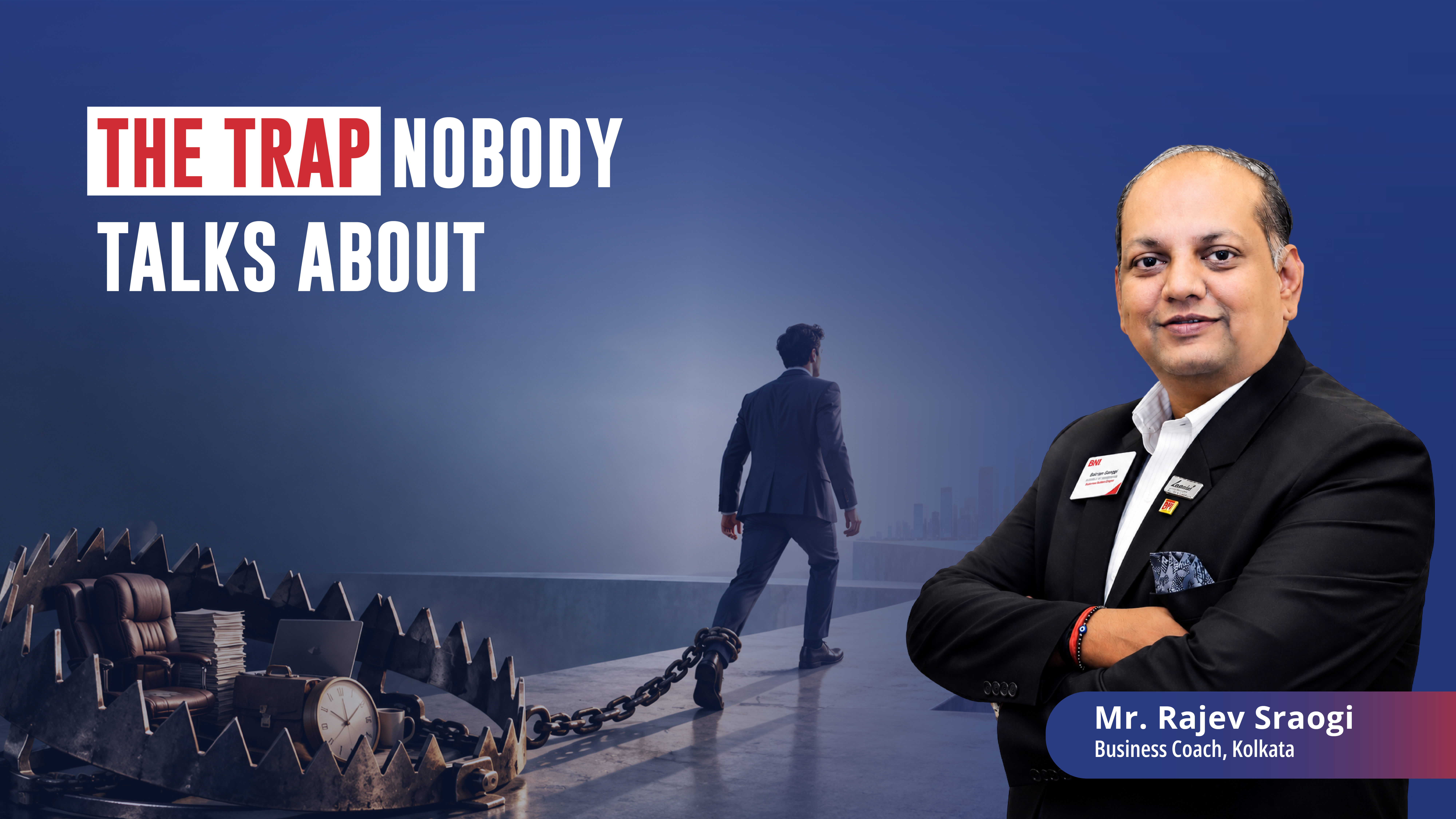
The Trap Nobody Talks About
Success has a strange way of making yesterday’s strengths look like tomorrow’s weaknesses.
The closer you stayed to the business, the stronger it became. The more decisions you took yourself, the faster things moved.
Until one day, the business grows, and those same strengths begin to hold it back.
In the early years, the question is: How do we make this work?
Later, it becomes: How do we make this work without everything depending on us?
That transition is rarely as comfortable as it sounds.
I have seen business owners build impressive companies through instinct, speed, personal relationships, and an extraordinary ability to stay close to every important decision. Those qualities often become part of the founder’s identity.
That is where the trap begins.
Because what made you successful at one stage can quietly become the reason you struggle at the next.
When Strengths Become Constraints
Consider control.
In the early stages of a business, being involved in everything can be a competitive advantage. You know the customer. You know the numbers. You know which supplier can be trusted, which employee needs attention, and which decision cannot wait.
You make decisions quickly because there is no distance between the problem and the person solving it.
But eventually, the business becomes too large for that model.
The same involvement that once created speed starts creating bottlenecks. People wait for your approval. Senior managers hesitate to make decisions. Important conversations keep coming back to you.
You may have built a larger business, but you have not necessarily built a more independent one.
The business has scaled. Your way of running it may not have.
That is an uncomfortable realisation for a successful entrepreneur.
The Experience Paradox
There is another trap that becomes more visible as entrepreneurs become successful: experience can make us very confident about what works.
That confidence is understandable.
You have made difficult decisions before. You have survived downturns. You have negotiated difficult deals. You have built relationships over decades. You have seen competitors come and go.
But experience can sometimes make us less willing to question the assumptions behind our success.
The market changes.
Customers change.
The organisation changes.
The next generation may think differently.
Yet the founder may continue applying the same decision-making logic that worked ten or fifteen years ago.
Not because they are unwilling to change. Because, quite simply, the old way worked.
The challenge is recognising when a proven approach has reached its useful life.
Success Can Create Distance
Interestingly, the more successful a business owner becomes, the harder it can be to receive an honest outside perspective.
People around you may have good reasons for agreeing with you. Employees depend on your leadership. Family members may avoid difficult conversations. Long-standing advisors may know your history but not necessarily challenge your assumptions. And when everyone around the table is familiar with your thinking, it becomes easy to mistake agreement for clarity.
This is one reason successful entrepreneurs need strong conversations outside their immediate circle.
Not networking for the sake of collecting contacts. Not another room where everyone talks about growth.
A room where someone can ask:
“Why are you still involved in this?”
“What would happen if you stopped approving this?”
“Is this decision genuinely strategic, or has it simply become your habit?”
Those questions can be more valuable than another business idea.
The Next Stage Requires a Different Founder
Every stage of business asks something different from its owner.
At one stage, you need to be close to the details.
At another, you need to build leaders who can handle those details.
At one stage, your relationships may drive growth.
Later, the organisation needs processes and institutional relationships that do not live only inside your phone.
At one stage, being the person with all the answers may be necessary.
Later, your job may be to create an organisation capable of finding better answers without you.
This is where many established businesses get stuck.
The owner continues doing what they are exceptionally good at, while the business quietly needs them to do something else.
The next stage of growth may not require more effort from you. It may require a different use of your experience.
What Are You Still Holding On To?
For successful entrepreneurs, letting go is rarely about laziness or a desire to work less.
It is often about identity.
If you built the business yourself, stepping back from certain decisions can feel like stepping back from the business itself.
But there is a meaningful difference between being responsible for the business and being required for every decision within it.
That distinction matters.
A strong business should increasingly carry the weight of its founder’s thinking through its people, systems, culture and leadership.
Otherwise, growth can become an expensive way of creating a more demanding job.
The real question is not whether the methods that brought you here were right.
They probably were.
The better question is whether they are still right for where you want the business to go next.
Because sometimes the biggest obstacle to the next stage is not a lack of opportunity.
It is our attachment to the version of ourselves that created the last one.
Moloy Chakravorty
Founder - Beyond Red Ocean Consulting
Executive Director - Network In Action, West Bengal
Author - Business Alchemy
Business Coach | Entrepreneur | Keynote Speaker