

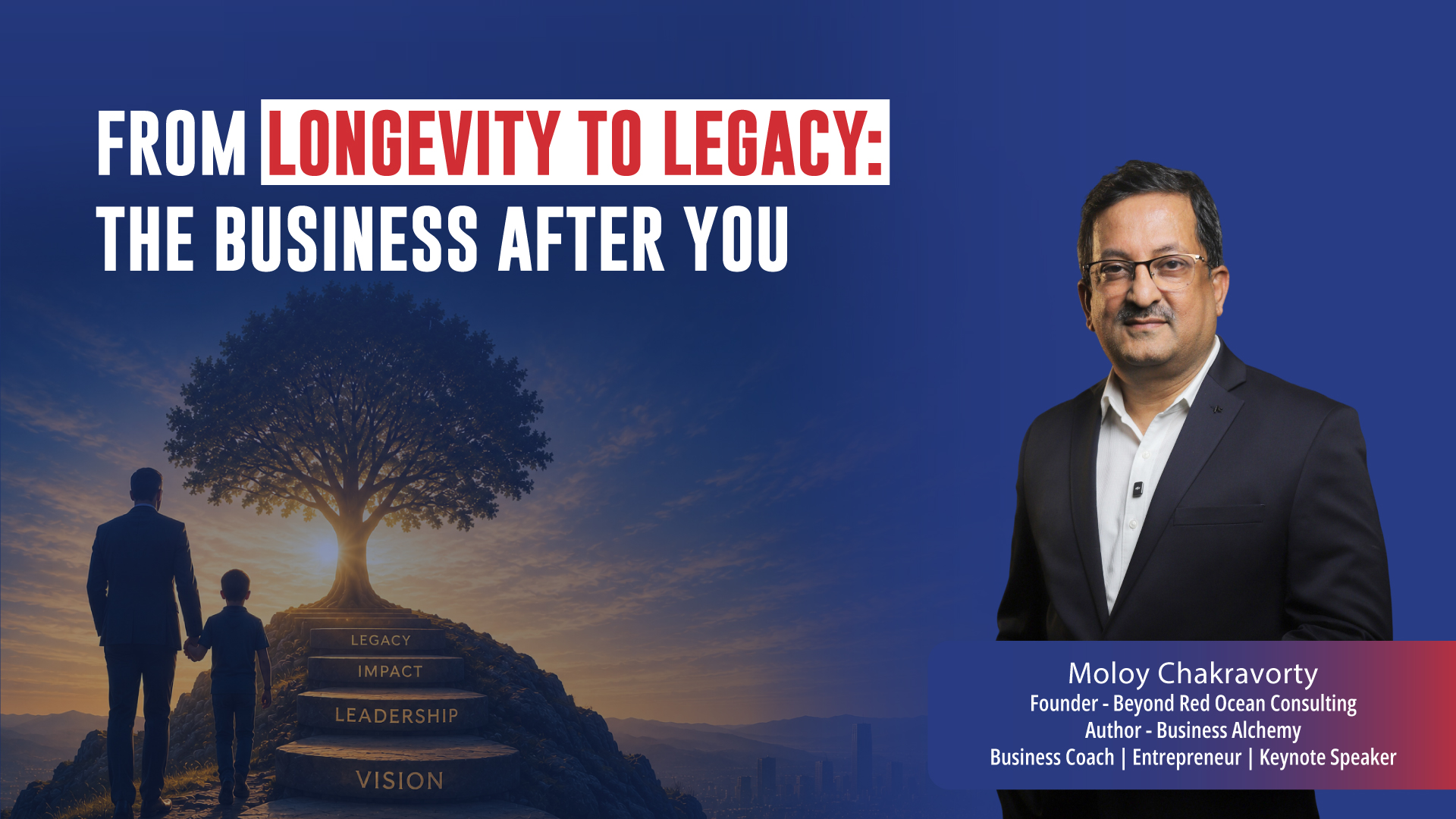
From Longevity to Legacy: The Business After You
I have spent years sitting with business owners who have built something remarkable.
Businesses that started with one person, one idea and years of sacrifice. Businesses that have survived difficult markets, changing customers, economic cycles and countless challenges.
And yet, there is one question many successful entrepreneurs find surprisingly difficult to answer:
What happens to the business when you are no longer running it?
The question becomes even more important when the next generation is preparing to step in.
According to PwC’s latest India Family Business Survey, 36% of Indian family businesses have no clear succession plan, while 21% have delayed the transition to the next generation because of uncertainty. Even more striking, 52% identify resistance from the senior generation as a major barrier to preparing the next generation for leadership.
These numbers tell us something important.
Succession is not simply about handing over ownership.
It is about handing over responsibility, decision-making, relationships, knowledge and, eventually, leadership.
You Cannot Hand Over What You Haven't Built
I often see founders spend decades building a business around themselves.
They know every important customer.
They approve every major decision.
They understand every critical process.
Their phone number is the number everyone calls when something goes wrong.
That may work for one generation. But it creates a very difficult question for the next one:
How does the next generation take charge of a business that has been designed around the founder?
The answer isn't simply to announce a new Managing Director or give the next generation a larger office.
They need exposure.
They need responsibility.
They need the opportunity to make decisions, face consequences, build relationships and earn the confidence of the organisation.
And the founder needs to learn something equally difficult:
How to let go without letting the business go.
Succession Is Not an Event
One of the biggest mistakes I see business families make is treating succession as something that begins when the founder decides to step away.
By then, it may already be too late.
A successful transition begins years before the actual handover.
It begins with conversations that many families keep postponing.
Who should lead?
Who is truly ready?
What should the next generation own?
What should they manage?
Where does professional management fit in?
And perhaps the most uncomfortable question:
What happens when the next generation wants to build the business differently?
These are not easy conversations.
But avoiding them does not make them disappear. It only makes them more difficult, more emotional and often more expensive when they eventually have to be addressed.
There is also a human side to succession that business plans often overlook.
For the founder, the business is rarely just an asset. It represents years of identity, sacrifice, relationships and personal decisions.
For the next generation, taking over can feel like stepping into someone else’s shadow while trying to build an identity of their own.
The transition works when both sides recognise this.
The founder has to create space for the next generation to lead.
The next generation has to earn the trust to do so.
And both have to understand that succession is not about deciding who gets the chair.
It is about preparing the business for a future where the chair belongs to someone else.
Succession succeeds when ownership is transferred with trust, not simply with authority.
From Founder Dependency to Business Independence
A true measure of entrepreneurial success is not how many decisions you can make in a day. It is how many important decisions your business can make without you. That requires systems.
It requires capable leaders.
It requires documented processes.
It requires a culture where responsibility is distributed rather than concentrated at the top.
Most importantly, it requires the founder to gradually move from being the person who runs the business to the person who builds the business's ability to run itself.
That is when longevity begins turning into legacy.
The Business After You
When I think about legacy, I don't think only about wealth or ownership. I think about whether the business continues to create value.
Whether employees continue to have opportunities.
Whether customers continue to trust the organisation.
Whether the next generation has something strong enough to build upon.
And whether the values that shaped the business survive even when the person who created them is no longer sitting at the head of the table.
You may have spent 20, 30 or 40 years building your business. The next responsibility is to make sure those years don't end with you.
Longevity is about how long your business survives.
Legacy is about what survives because you built it.
And perhaps the greatest achievement of an entrepreneur is not building a business that needs them forever. It is building one that is strong enough to continue without them.
Moloy Chakravorty
Founder - Beyond Red Ocean Consulting
Executive Director - Network In Action, West Bengal
Author - Business Alchemy
Business Coach | Entrepreneur | Keynote Speaker